2.4 KiB
| title | topics | contributors | software | sites | |||||
|---|---|---|---|---|---|---|---|---|---|
| Study highlight - Age- and sex-related changes in motor functions |
|
|
|
|
{{< lead >}}
This study provides an example of data analysis enabled by using DataLad to create a database of motor parameters in healthy individuals and patients with neurological and psychiatric disorders.
{{< /lead >}}
In a study published in Frontiers in Aging Neuroscience, researchers from ABCD-J sites, [University of Cologne]({{< relref path="../../sites/ucologne" lang="en" >}}) and [Research Centre Jülich]({{< relref path="../../sites/fzj" lang="en" >}}) showcase the potential of reproducible neuroscience through the use of a [DataLad]({{< relref path="../../software/datalad" lang="en" >}})-based database of motor parameters. The data were collected by conducting comprehensive motor assessments among 444 non-left-handed adults without history of neurological, psychiatric, or orthopedic diseases. The assessments included five standardized tests to evaluate basic (grip strength, finger-tapping frequency) and complex (Action Research Arm Test, Jebsen-Taylor Hand Function Test, Purdue Pegboard Test) motor functions.
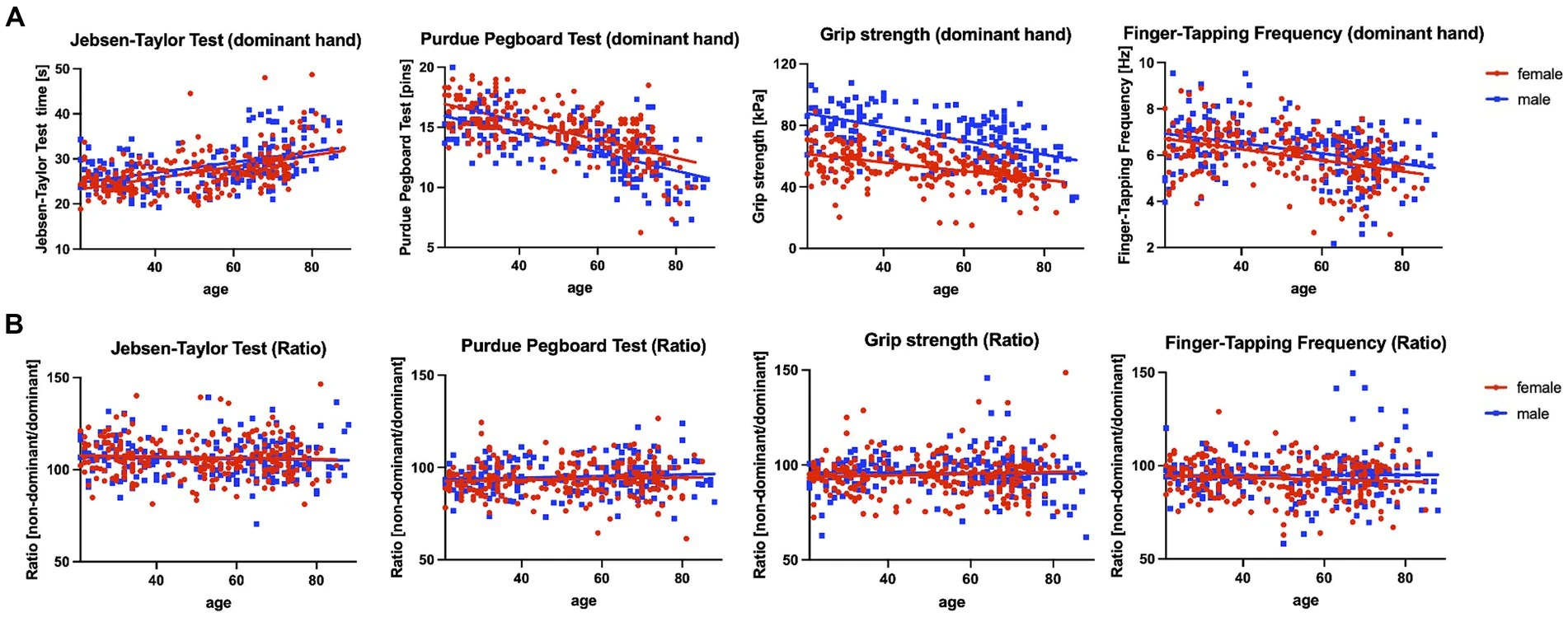
The study revealed reduced motor function across the lifespan, with significant sex-specific differences. Namely, men demonstrated higher grip strengths and finger-tapping frequencies, while women outperformed men in the Purdue Pegboard Test. Motor performance could predict the age of the participants, and Principal Component Analysis (PCA) unveiled three robust motor components: dexterity, force, and speed.
These results not only provide a comprehensive assessment of age- and sex-dependent motor functions in healthy individuals, but also illustrate the type of insight that becomes possible with reusable, well-structured datasets. By leveraging DataLad to build the database behind these data, this work lays the groundwork for a scalable resource that can support future motor function research. For example, the data and results presented in this study could inform a future study to classify depressive patients using motor parameters.