
4.8 KiB
| title | topics | contributors | software | sites | |||||||||
|---|---|---|---|---|---|---|---|---|---|---|---|---|---|
| Case study - Metadata pooling for the TRR379 research consortium |
|
|
|
|
{{< lead >}}
Within the ABCD-J context, we have developed a (meta)data management approach that enables collaborative, model-driven collection and reuse of research information across distributed sites and projects.
{{< /lead >}}
Large-scale distributed research collaborations often face a common problem: metadata about data, tools, contributors, and other research activities are typically fragmented across heterogeneous systems. ABCD-J contributors are addressing this gap by developing shared metadata infrastructure for collaborative research center project sites to pool, enrich, query, and reuse research information. In particular, the DFG-funded collaborative research center, TRR379 (Neuropsychobiology of Agression: A Transdiagnostic Approach in Mental Disorders), serves as the most comprehensive deployment to date, demonstrating how metadata can facilitate scientific advancement and communication, as well as simplified administrative processses.
The system
At the core of the TRR379 research metadata system is a metadata pooling service that supports structured collection, enrichment, querying, and reuse of research information across distributed sites and users. It consists of two key software components:
- A server-side metadata store and API, the Dump Things Service
- A web UI for structured data entry, powered by shacl-vue
Importantly, these software components derive their structure dynamically from a use-case specific schema (specified using LinkML), allowing the same tool stack to be used across domains. At the same time, the underlying generic schema components remain closely aligned with semantic standards such as the World Wide Web Consortium (W3C) Provenance Ontology (PROV-O), ensuring interoperability between domains as well as long-term extensibility. With this design, metadata becomes reusable across different service deployments and downstream applications, independent of whether the information is ultimately used to generate web pages, reports, data catalogs, or other outputs.
Code development, authentication, and automated workflows for enrichment, querying, and output generation are all suppported via a collaborative and self-hosted forgejo-aneksajo deployment at https://hub.trr379.de/. Together with the metadata pooling service, this provides a shared infrastructure enabling distributed teams to describe and manage research activities.
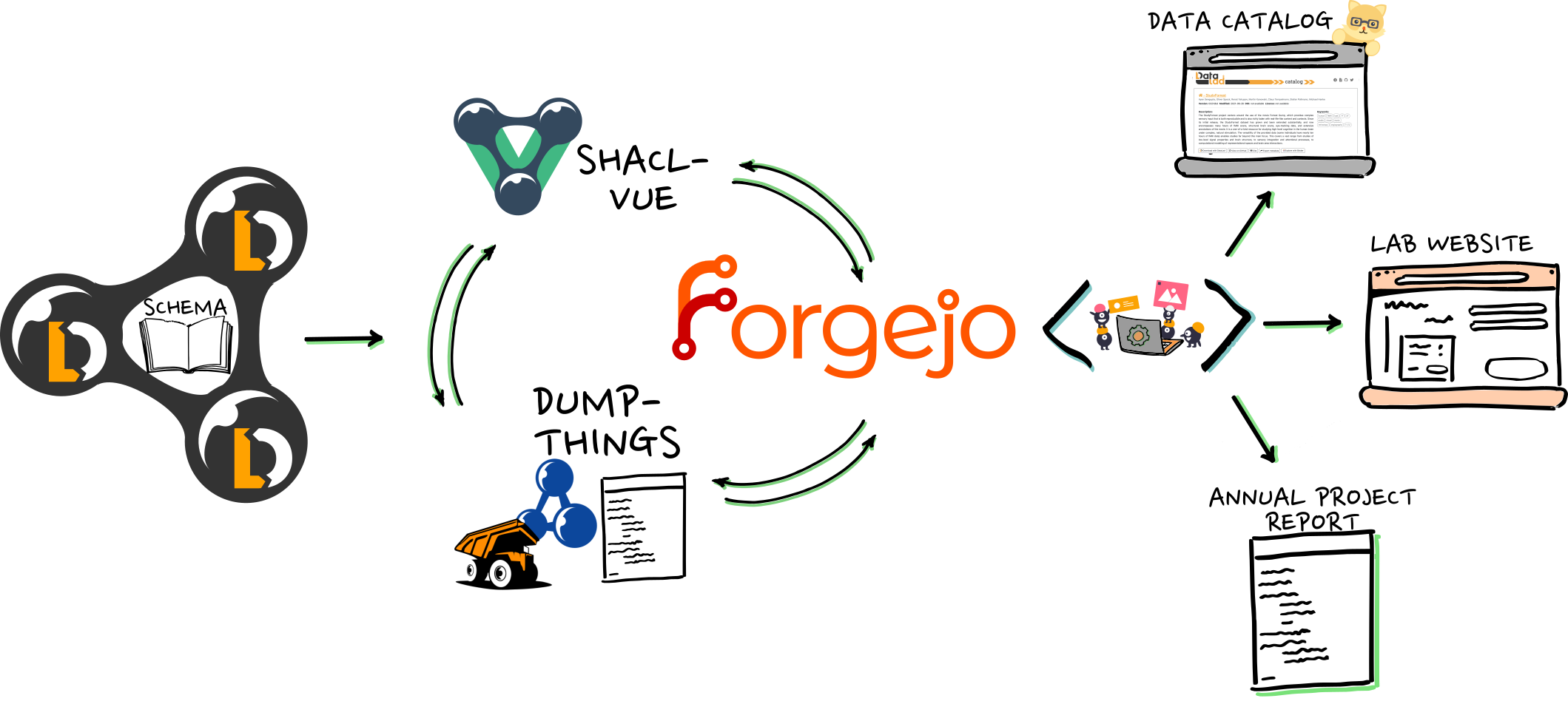
In the TRR379 setting, metadata is not treated as an administrative by-product, but rather as an active coordination layer. It enables:
- aggregation of information on datasets, tools, projects, publications, etc. across sites
- structured reuse of metadata for reporting and communications
- automated generation of consortium-facing content
A particularly visible outcome is that much of the TRR379 website is now automatically generated from the underlying metadata infrastructure, enabling continuous synchronization of research activities and their public representation. As an example for how the metadata system can support administrative workflows, such as meeting reporting requirements of funding agencies, the TRR379 implemented the DFG's annual survey on coordinated programmes using the integrated metadata system.
The significance
The TRR379 represents a real-world validation of the integrated service ecosystem developed across the ABCD-J platform. In this case, the infrastructure combines:
- a central collaboration platform
- a metadata pooling and curation system
- tools and workflows to link and disseminate research information
This deployment demonstrates how a federated, model-driven metadata layer can support FAIR (meta)data management in scientific workflows and to meet administrative requirements. It also illustrates how research outputs and organizational information can be maintained in a continuously updated, machine-readable form to improve (meta)data consistency and reuse.