Several miscellaneous updates to the ABCD-J website #3
1
.DS_Store
vendored
Normal file
|
|
@ -0,0 +1 @@
|
|||
/annex/objects/MD5E-s6148--99cd75ed1ae3db7858e9e50a95c1319c
|
||||
|
|
@ -12,7 +12,10 @@ mainSections = ["news"]
|
|||
description = "Offizielle Webseite des ABCD-J Projektes"
|
||||
|
||||
[params.author]
|
||||
name = "ABCD-J"
|
||||
name = """
|
||||
|
|
||||
Accessing Behavior for Clinical Data and Joint Usage
|
||||
(ABCD-J)
|
||||
"""
|
||||
bio = "Das ABCD-J-Projekt wird gefördert vom MKW-NRW: Ministerium für Kultur und Wissenschaft des Landes Nordrhein-Westfalen im Rahmen des Programms Kooperationsplattformen 2022, Förderkennzeichen: KP22-106A"
|
||||
headline = "Eine Plattform für digitale Biomarker und mobile health in NRW"
|
||||
links = [
|
||||
|
|
|
|||
|
|
@ -12,7 +12,10 @@ mainSections = ["news"]
|
|||
description = "Main website of the ABCD-J Project"
|
||||
|
||||
[params.author]
|
||||
name = "ABCD-J"
|
||||
name = """
|
||||
Accessing Behavior for Clinical Data and Joint Usage
|
||||
(ABCD-J)
|
||||
"""
|
||||
# image = "trr-puzzle.png"
|
||||
headline = "A platform for digital biomarkers and mhealth in Northrhine Westfalia"
|
||||
bio = "The ABCD-J project is funded by the MKW-NRW: Ministerium für Kultur und Wissenschaft des Landes Nordrhein-Westfalen under the Kooperationsplattformen 2022 program, grant number: KP22-106A."
|
||||
|
|
|
|||
|
|
@ -21,7 +21,7 @@
|
|||
weight = 20
|
||||
|
||||
[[main]]
|
||||
name = "Partner"
|
||||
name = "Personen"
|
||||
pageRef = "contributors"
|
||||
weight = 30
|
||||
|
||||
|
|
@ -75,13 +75,6 @@ weight = 40
|
|||
[footer.params]
|
||||
icon = "law"
|
||||
|
||||
[[footer]]
|
||||
name = "Daten"
|
||||
url = "https://data.abcd-j.de"
|
||||
weight = 50
|
||||
[footer.params]
|
||||
icon = "lightbulb"
|
||||
|
||||
|
||||
[[footer]]
|
||||
name = "Docs"
|
||||
|
|
|
|||
|
|
@ -21,7 +21,7 @@
|
|||
weight = 20
|
||||
|
||||
[[main]]
|
||||
name = "Partner"
|
||||
name = "People"
|
||||
pageRef = "contributors"
|
||||
weight = 30
|
||||
|
||||
|
|
@ -71,19 +71,12 @@ icon = "news"
|
|||
|
||||
|
||||
[[footer]]
|
||||
name = "Imprint"
|
||||
name = "Legal"
|
||||
pageRef = "imprint"
|
||||
weight = 40
|
||||
[footer.params]
|
||||
icon = "law"
|
||||
|
||||
[[footer]]
|
||||
name = "data"
|
||||
url = "https://data.abcd-j.de"
|
||||
weight = 50
|
||||
[footer.params]
|
||||
icon = "lightbulb"
|
||||
|
||||
|
||||
[[footer]]
|
||||
name = "Docs"
|
||||
|
|
|
|||
1
content/.DS_Store
vendored
Normal file
|
|
@ -0,0 +1 @@
|
|||
/annex/objects/MD5E-s8196--90ad9c4ef800520781841c8199da3dd0
|
||||
|
|
@ -1,5 +1,4 @@
|
|||
|
||||

|
||||

|
||||
|
||||
<div class="prose dark:prose-invert text-center" style="margin:auto">
|
||||
|
||||
|
|
|
|||
|
|
@ -1,4 +1,4 @@
|
|||

|
||||

|
||||

adina
commented
I like the figure caption in general, but on the front page it feels a bit odd, like the intro to the clinical partners below... What do you think? 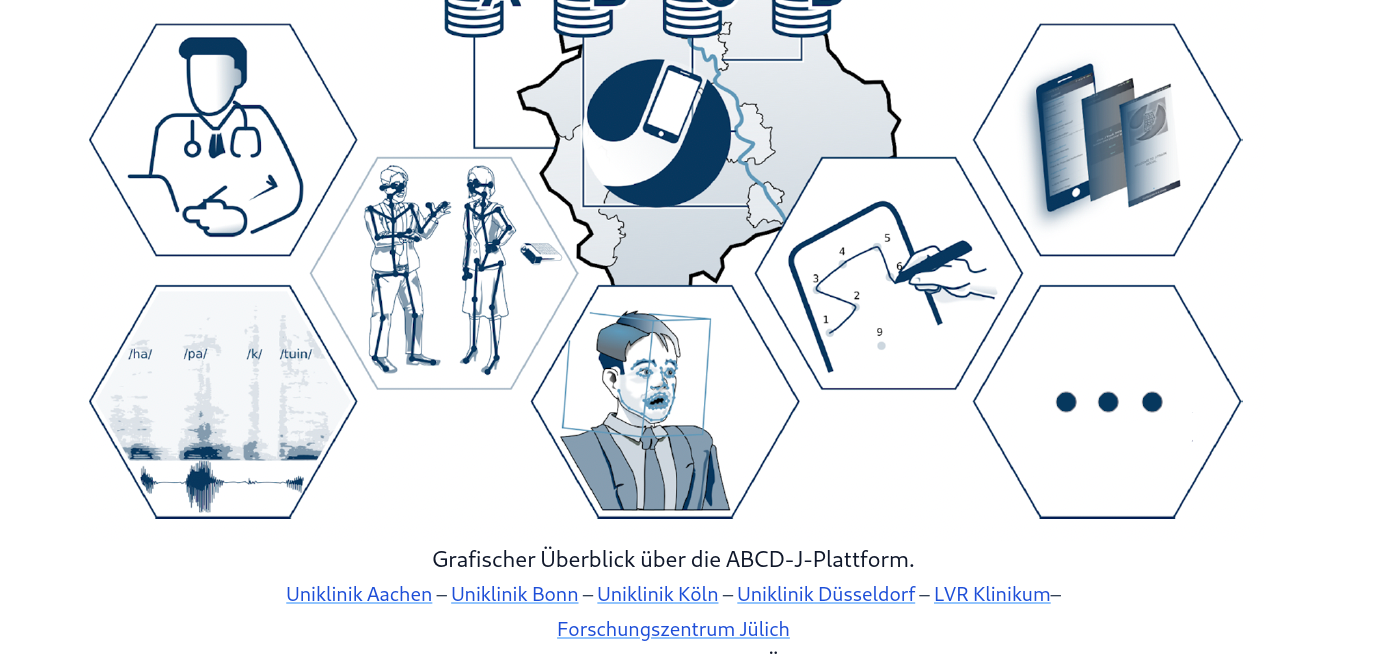
I like the figure caption in general, but on the front page it feels a bit odd, like the intro to the clinical partners below... What do you think?

j.goddard
commented
Agreed - I've removed the caption from this image. Agreed - I've removed the caption from this image.
|
||||
|
||||
<div class="prose dark:prose-invert text-center" style="margin:auto">
|
||||
|
||||
|
|
|
|||
|
|
@ -2,8 +2,8 @@
|
|||
Title: Das ABCD-J Verbundprojekt
|
||||
---
|
||||
|
||||
Das gemeinschaftliche ABCD-J Forschungprojekt ist ein Zusammenschluss von fünf Forschungsinstitutionen in Nordrhein-Westfalen: Der Universitätskliniken Bonn, Köln, Düsseldorf, sowie der RWTH Aachen, und dem Forschungszentrum Jülich. Das übergeordnete Ziel des ABCD-J Projektes ist es, existierende technische Infrastruktur zur konkreten wissenschaftlichen Anwendung zu bringen.
|
||||
Dazu entwickeln wir interoperable Technologien zur Datenerhebung, Datenmanagement, und ML-basierten Datenanalyse.
|
||||
Das gemeinschaftliche ABCD-J Forschungprojekt ist ein Zusammenschluss von fünf [Forschungsinstitutionen]({{< relref "/sites" >}}) in Nordrhein-Westfalen: Der Universitätskliniken Bonn, Köln, Düsseldorf, sowie der RWTH Aachen, und dem Forschungszentrum Jülich. Das übergeordnete Ziel des ABCD-J Projektes ist es, existierende technische Infrastruktur zur konkreten wissenschaftlichen Anwendung zu bringen.
|
||||
Dazu entwickeln wir interoperable [Technologien]({{< relref "/software" >}}) zur Datenerhebung, Datenmanagement, und auf machinellem Lernen basierende Datenanalyse.
|
||||
Gemeinsam ergeben diese Softwarekomponenten mehr als die Summe ihrer Teile: Eine vollständige Datenerhebungs- und Analyseumgebung für klinische Forschung, von Studienkonzeption bis hin zur Anwendung zum Wohle des Patienten.
|
||||
|
||||
<img style="margin:auto" src="abcdj_platform.de.svg"
|
||||
|
|
@ -16,7 +16,7 @@ Auf sozialer Ebene fördert und erleichtert das ABCD-J Projekt Kollaborationen z
|
|||
alt="Schematische Übersicht der ABCD-J Platform"
|
||||
/>
|
||||
|
||||
Die ABCD-J Plattform bietet klinisch Forschenden der Bereiche Neurologie und Psychiatrie eine digitale Infrastruktur, die 1) die Sammlung von Daten mit Hilfe mobiler Gesundheitstechnologien, 2) die Harmonisierung und Verwaltung von Daten gemäß den FAIR-Prinzipien (Findable, Accessible, Interoperable, Reusable) und 3) die automatisierte Analyse von Daten mit Hilfe von Algorithmen des maschinellen Lernens mit dem Ziel der Entwicklung digitaler Biomarker ermöglicht.
|
||||
Die ABCD-J Plattform bietet klinisch Forschenden der Bereiche Neurologie und Psychiatrie eine digitale Infrastruktur, die 1) die Sammlung von Daten mit Hilfe mobiler Gesundheitstechnologien, 2) die Harmonisierung und Verwaltung von Daten gemäß den [FAIR](https://doi.org/10.1038/sdata.2016.18)-Prinzipien (Findable, Accessible, Interoperable, Reusable) und 3) die automatisierte Analyse von Daten mit Hilfe von Algorithmen des maschinellen Lernens mit dem Ziel der Entwicklung digitaler Biomarker ermöglicht.
|
||||
|
||||
Einen Überblick über das ABCD-J Projekt ist auch als Flyer verfügbar:
|
||||
[Download Flyer {{< icon "chevron-down" >}}](/info/abcd-j-plattform.pdf)
|
||||
|
|
|
|||
|
|
@ -2,8 +2,8 @@
|
|||
Title: About ABCD-J
|
||||
---
|
||||
|
||||
The ABCD-J research community project is a collaboration between five research institutions in the German state of North Rhine-Westphalia: University Clinic RWTH Aachen, University Clinic Bonn, University Clinic Köln, University Clinic Düsseldorf and Research Centre Jülich. The overarching goal of ABCD-J is to elevate existing technical solutions for research practice adoption.
|
||||
To this end, we develop interoperable technologies for data collection, data management and ML-based data analysis.
|
||||
The ABCD-J research community project is a collaboration between five [research institutions]({{< relref "/sites" >}}) in the German state of North Rhine-Westphalia: University Clinic RWTH Aachen, University Clinic Bonn, University Clinic Köln, University Clinic Düsseldorf and Research Centre Jülich. The overarching goal of ABCD-J is to elevate existing technical solutions for research practice adoption.
|
||||
To this end, we develop interoperable [technologies]({{< relref "/software" >}}) for data collection, data management and machine learning-based data analysis.
|
||||
Together, these software components add up to more than the sum of their parts: A complete data collection and analysis environment for clinical research, from study design to application for the benefit of the patient.
|
||||
|
||||
<img style="margin:auto" src="abcdj_platform.svg"
|
||||
|
|
@ -16,7 +16,7 @@ From the social perspective, the ABCD-J project aims to promote and facilitate c
|
|||
alt="Envisioned data flow in the ABCD-J project"
|
||||
/>
|
||||
|
||||
The ABCD-J platform provides clinical researchers in the field of neurology and psychiatry with a digital infrastructure that allows 1) the collection of data using mobile health technologies, 2) the harmonization and management of data according to FAIR (Findable, Accessible, Interoperable, Reusable) principles, and 3) the automated analysis of data using machine learning algorithms with the goal of developing digital biomarkers.
|
||||
The ABCD-J platform provides clinical researchers in the field of neurology and psychiatry with a digital infrastructure that allows 1) the collection of data using mobile health technologies, 2) the harmonization and management of data according to [FAIR](https://doi.org/10.1038/sdata.2016.18) (Findable, Accessible, Interoperable, Reusable) principles, and 3) the automated analysis of data using machine learning algorithms with the goal of developing digital biomarkers.
|
||||
|
||||
|
||||
An overview of the ABCD-J project is also available as an easily digestible leaflet:
|
||||
|
|
|
|||
1
content/contributors/.DS_Store
vendored
Normal file
|
|
@ -0,0 +1 @@
|
|||
/annex/objects/MD5E-s6148--d0722cbab66bd29dbf38e6bb149e9d11
|
||||
|
|
@ -6,10 +6,10 @@ layout: list
|
|||
|
||||
ABCD-J ist ein Verbundprojekt mit einer Vielzahl klinischer, wissenschaftlicher und technischer Expertise. Viele Menschen leisten dazu in verschiedenen [Rollen]({{< relref "/roles" >}}) wertvolle Beiträge:
|
||||
|
||||
- [Principal investigator / Projektleitung]({{< relref "/roles/pi" >}})
|
||||
- [Principal Investigator / Projektleitung]({{< relref "/roles/pi" >}})
|
||||
- [Community Manager]({{< relref "/roles/community-manager" >}})
|
||||
- [Research Software Engineer]({{< relref "/roles/developer" >}})
|
||||
- [Klinisch Forschende]({{< relref "/roles/scientist" >}})
|
||||
|
||||
- [Standortleitung]({{< relref "/roles/lead" >}})
|
||||
|
||||
Hier sind die Menschen hinter dem Projekt:
|
||||
|
|
@ -7,10 +7,11 @@ ABCD-J is a collaborative initiative with various research, clinical, and techni
|
|||
contribute their expertise in various [roles]({{< relref "/roles" >}}), such
|
||||
as:
|
||||
|
||||
- [Principal investigator / project lead]({{< relref "/roles/pi" >}})
|
||||
- [Principal Investigator / Project Lead]({{< relref "/roles/pi" >}})
|
||||
- [Community Manager]({{< relref "/roles/community-manager" >}})
|
||||
- [Research Software Engineer]({{< relref "/roles/developer" >}})
|
||||
- [Clinical Scientist]({{< relref "/roles/scientist" >}})
|
||||
- [Site Lead]({{< relref "/roles/lead" >}})
|
||||
|
||||
|
||||
These are the people behind the project:
|
||||
|
|
|
|||
|
|
@ -6,6 +6,7 @@ sites:
|
|||
- ubonn
|
||||
roles:
|
||||
- pi
|
||||
- lead
|
||||
layout: contributor
|
||||
#layout:
|
||||
#feature:
|
||||
|
|
|
|||
|
|
@ -6,6 +6,7 @@ sites:
|
|||
- ubonn
|
||||
roles:
|
||||
- pi
|
||||
- lead
|
||||
layout: contributor
|
||||
#layout:
|
||||
#feature:
|
||||
|
|
|
|||
|
|
@ -10,12 +10,11 @@ layout: contributor
|
|||
params:
|
||||
orcid: 0000-0002-0181-0828
|
||||
name-title: Dr.
|
||||
affiliation: Institute of Neuroscience and Medicine (INM-7), Research Center Jülich
|
||||
affiliation: Institut für Neurowissenschaften und Medizin (INM-7), Forschungszentrum Jülich
|
||||
seealso-link:
|
||||
seealso-text:
|
||||
portrait: thumbnail.jpeg
|
||||
portrait: portrait.webp
|
||||
sortkey: "Swarthout Goddard, Jenna"
|
||||
---
|
||||
|
||||
|
||||
Dr. Jenna Swarthout Goddard erhielt ihren Doktorgrad in Umweltgesundheit an der Tufts Universität, und hat umfassende Erfahrungen als Community Managerin in zahlreichen Projekten.
|
||||
|
|
@ -6,6 +6,7 @@ sites:
|
|||
- ucologne
|
||||
roles:
|
||||
- pi
|
||||
- lead
|
||||
layout: contributor
|
||||
#layout:
|
||||
#feature:
|
||||
|
|
|
|||
|
|
@ -6,6 +6,7 @@ sites:
|
|||
- ucologne
|
||||
roles:
|
||||
- pi
|
||||
- lead
|
||||
layout: contributor
|
||||
#layout:
|
||||
#feature:
|
||||
|
|
|
|||
|
|
@ -6,6 +6,7 @@ sites:
|
|||
- rwth
|
||||
roles:
|
||||
- pi
|
||||
- lead
|
||||
layout: contributor
|
||||
#layout:
|
||||
#feature:
|
||||
|
|
|
|||
|
|
@ -6,6 +6,7 @@ sites:
|
|||
- rwth
|
||||
roles:
|
||||
- pi
|
||||
- lead
|
||||
layout: contributor
|
||||
#layout:
|
||||
#feature:
|
||||
|
|
|
|||
|
|
@ -7,6 +7,7 @@ sites:
|
|||
- hhu
|
||||
roles:
|
||||
- pi
|
||||
- lead
|
||||
layout: contributor
|
||||
#layout:
|
||||
#feature:
|
||||
|
|
|
|||
|
|
@ -7,6 +7,7 @@ sites:
|
|||
- hhu
|
||||
roles:
|
||||
- pi
|
||||
- lead
|
||||
layout: contributor
|
||||
#layout:
|
||||
#feature:
|
||||
|
|
|
|||
|
|
@ -6,6 +6,7 @@ sites:
|
|||
- hhu
|
||||
roles:
|
||||
- pi
|
||||
- lead
|
||||
layout: contributor
|
||||
#layout:
|
||||
#feature:
|
||||
|
|
|
|||
|
|
@ -6,6 +6,7 @@ sites:
|
|||
- hhu
|
||||
roles:
|
||||
- pi
|
||||
- lead
|
||||
layout: contributor
|
||||
#layout:
|
||||
#feature:
|
||||
|
|
|
|||
|
|
@ -7,10 +7,12 @@ Damit macht er die Daten auffindbar - das F ("Findable") in [FAIR](https://doi.o
|
|||
Gleichzeitig sind nicht alle Daten im Katalog frei zugänglich.
|
||||
Datensätze können aber Ansprechpartner oder Nutzungsbedingungen spezifizieren, über die ein Zugang erfragt werden kann.
|
||||
|
||||
[{{< icon "lightbulb" >}} Direkt zum Datenkatalog](https://data.abcd-j.de)
|
||||
{{< button href="https://data.abcd-j.de" >}}
|
||||
{{< icon "lightbulb" >}} Direkt zum Datenkatalog
|
||||
{{< /button >}}
|
||||
|
||||
Wussten Sie, dass auch Sie Ihre Daten mit dem Katalog verlinken können, ohne sie hochladen zu müssen?
|
||||
|
||||

|
||||
|
||||
Unsere Dokumentation zeigt in wenigen Schritten, wie neue Datenkatalogeinträge entstehen: [{{< icon "document" >}} docs.abcd-j.de](https://data.abcd-j.de).
|
||||
Unsere Dokumentation zeigt in wenigen Schritten, wie neue Datenkatalogeinträge entstehen: [{{< icon "document" >}} rdm.abcd-j.de](https://rdm.abcd-j.de).
|
||||
|
|
@ -5,12 +5,14 @@ Title: Decentral Data Catalog
|
|||
The data catalog provides an overview of a large number of data sets that have been collected and shared in partner institutions.
|
||||
This makes the data findable - the F (“Findable”) in [FAIR](https://doi.org/10.1038/sdata.2016.18).
|
||||
At the same time, not all data in the catalog is freely accessible.
|
||||
However, datasets can specify contact persons or terms of use via which access can be requested.
|
||||
However, data sets can specify contact persons or terms of use via which access can be requested.
|
||||
|
||||
[{{< icon "lightbulb" >}} Take me to the catalog!](https://data.abcd-j.de)
|
||||
{{< button href="https://data.abcd-j.de" >}}
|
||||
{{< icon "lightbulb" >}} Take me to the catalog!
|
||||
{{< /button >}}
|
||||
|
||||
Did you know that you, too, can link your data to the catalog without having to upload it?
|
||||
|
||||

|
||||

|
||||
|
||||
Our documentation demonstrates how new data catalog entries are created in just a few steps : [{{< icon "document" >}} docs.abcd-j.de](https://data.abcd-j.de).
|
||||
Our documentation demonstrates how new data catalog entries are created in just a few steps : [{{< icon "document" >}} rdm.abcd-j.de](https://rdm.abcd-j.de/).
|
||||
|
|
@ -21,7 +21,7 @@ Steuer-Nr.: 213/5700/0033
|
|||
|
||||
### Geschäftsführung:
|
||||
- Prof. Dr. Astrid Lambrecht (Vorsitzende)
|
||||
- Karsten Beneke (Stellvertr. Vorsitzender)
|
||||
- Dr. Stephanie Bauer (Stellvertr. Vorsitzende)
|
||||
- Dr. Ir. Pieter Jansens
|
||||
|
||||
### Vorsitzender des Aufsichtsrats:
|
||||
|
|
@ -64,4 +64,4 @@ Die Webseiten des ABCD-J Projektes enthalten Links auf die Webseiten Dritter. Di
|
|||
|
||||
#### Datenerhebung
|
||||
|
||||
Die ABCD-J-Website wird von [GitHub Pages](https://pages.github.com/?(null)) gehostet. Bei jedem Zugriff eines Nutzers auf eine Seite aus dem Angebot der ABCD-J wird die IP-Adresse des Nutzers zu Sicherheitszwecken protokolliert und gespeichert, unabhängig davon, ob der Nutzer sich bei GitHub angemeldet hat oder nicht. Weitere Informationen zu den Sicherheitspraktiken von GitHub finden Sie unter [GitHub-Datenschutzerklärung](https://docs.github.com/en/site-policy/privacy-policies/github-privacy-statement).
|
||||
Bei jedem Zugriff eines Nutzers auf diese Website und bei jedem Abruf einer Datei werden Daten über diesen Vorgang in einer Protokolldatei gespeichert. Diese Daten enthalten keine personenbezogenen Informationen; wir können also nicht nachvollziehen, welcher Nutzer welche Informationen abgerufen hat. Personenbezogene Nutzerprofile können daher nicht erstellt werden. Die gespeicherten Daten werden ausschließlich zu statistischen Zwecken ausgewertet. Eine Weitergabe dieser Daten an Dritte erfolgt nicht.
|
||||
|
|
|
|||
|
|
@ -22,7 +22,7 @@ Tax No.: 213/5700/0033
|
|||
### Board of Directors:
|
||||
|
||||
- Prof. Dr. Astrid Lambrecht (Chair of the Board of Directors)
|
||||
- Karsten Beneke (Vice-Chairman)
|
||||
- Dr. Stephanie Bauer (Vice-Chairwoman)
|
||||
- Dr. Ir. Pieter Jansens
|
||||
|
||||
### Supervisory Board:
|
||||
|
|
@ -64,4 +64,4 @@ This website may contain links to external third-party websites. These links to
|
|||
|
||||
#### Data Collection
|
||||
|
||||
The ABCD-J website is hosted by [GitHub Pages](https://pages.github.com/?(null)). Every time a user accesses a website hosted GitHub Pages, the visitor's IP address is logged and stored for security purposes, regardless of whether the visitor has signed into GitHub or not. For more information about GitHub's security practices, see [GitHub Privacy Statement](https://docs.github.com/en/site-policy/privacy-policies/github-privacy-statement).
|
||||
Every time a user accesses this website, and every time a file is requested, data connected to these processes are stored in a log. These data do not contain personal information; we are unable to trace which user accessed what information. Personal user profiles therefore cannot be created. The data that is saved will be used for statistical purposes only. This information will not be disclosed to third parties.
|
||||
|
|
|
|||
3
content/roles/lead/_index.de.md
Normal file
|
|
@ -0,0 +1,3 @@
|
|||
---
|
||||
title: Standortleitung
|
||||
---
|
||||
3
content/roles/lead/_index.md
Normal file
|
|
@ -0,0 +1,3 @@
|
|||
---
|
||||
title: Site Lead
|
||||
---
|
||||
|
|
@ -6,6 +6,6 @@ params:
|
|||
sortkey: 2
|
||||
---
|
||||
|
||||
Das Universitätsklinikum Bonn (UKB) ist ein Krankenhaus der Maximalversorgung mit 1341 Betten. Etwa 9.200 Mitarbeiter arbeiteten dort in Forschung, Lehre und Krankenversorgung sowie im öffentlichen Gesundheitswesen (Stand 2023).
|
||||
The Universitätsklinikum Bonn (UKB) is a maximum care hospital with 1341 beds. Around 9,200 employees work there in research, teaching and healthcare as well as in the public healthcare system (as of 2023).
|
||||
|
||||
## Related to this project site
|
||||
|
|
|
|||
|
|
@ -1,11 +1,11 @@
|
|||
---
|
||||
title: Software
|
||||
title: Software-Technologien
|
||||
layout: list
|
||||
---
|
||||
|
||||
ABCD-J verbindet drei hochrelevante, technische Themenschwerpunkte:
|
||||
|
||||
- [Erhebung von digitalen Biomarkern und mhealth Daten]({{< relref "/topics/mhealth" >}})
|
||||
- [Erhebung von digitalen Biomarkern und mobile Gesundheit Daten]({{< relref "/topics/mhealth" >}})
|
||||
- [FAIRes Forschungsdatenmanagement]({{< relref "/topics/datamanagement" >}})
|
||||
- [Robustes und verzerrungsfreies maschinelles Lernen]({{< relref "/topics/robustml" >}})
|
||||
|
||||
|
|
|
|||
|
|
@ -1,11 +1,11 @@
|
|||
---
|
||||
title: Software
|
||||
title: Software Technologies
|
||||
layout: list
|
||||
---
|
||||
|
||||
ABCD-J combines three highly relevant, technical topics:
|
||||
|
||||
- [Digital Biomarker assessment and mhealth]({{< relref "/topics/mhealth" >}})
|
||||
- [Digital biomarker assessment and mobile health]({{< relref "/topics/mhealth" >}})
|
||||
- [FAIR research data management]({{< relref "/topics/datamanagement" >}})
|
||||
- [Robust and bias-free machine learning]({{< relref "/topics/robustml" >}})
|
||||
|
||||
|
|
|
|||
|
|
@ -2,10 +2,10 @@
|
|||
title: Schwerpunkte
|
||||
---
|
||||
|
||||
Innerhalb von ABCD-J wird neben der klinischen Translation die Entwicklung von drei technischen Softwareprojekte vorangetrieben.
|
||||
Innerhalb von ABCD-J wird neben der klinischen Translation die Entwicklung von drei technischen [Softwareprojekte]({{< relref "/software" >}}) vorangetrieben.
|
||||
Diese Software - das [JTrack Ökosystem]({{< relref "/software/jtrack" >}}) für Smartphone-gestützte Erhebungungen, das [DataLad Ökosystem]({{< relref "/software/datalad" >}}) für Datenmanagement und reproduzierbare Wissenschaft, und die [julearn Bibliothek]({{< relref "/software/julearn" >}}) für verzerrungsfreie, vertrauenswürde Modelle des maschinellen Lernens - sind eigenständige Tools, die eigenständig und einzeln nutzbar sind.
|
||||
Im interoperablen Zusammenschluss miteinander ergeben diese Tools jedoch eine integrierte Erhebungs- und Analyseumgebung -- mehr als die Summe ihrer Teile.
|
||||
|
||||

|
||||
|
||||

|
||||
|
||||
Eine erfolgreiche Kooperationsplattform sollte technische Möglichkeiten und soziale Interaktionen eng miteinander verzahnen. Die ABCD-J Plattform ist Grundlage und Treiber für standortübergreifende Projekte, den sicheren Austausch von Daten und die Möglichkeit, neuste methodische Ansätze in der Breite nutzen zu können. Dieses Potential kann aber nur gehoben werden, wenn gleichzeitig ein intensiver Austausch zwischen den Partnern stattfindet und über entsprechende Community Management und Netzwerkaktivitäten die Zusammenarbeit in der Region gestärkt sowie auf potentielle neue (Transfer-) Partner erweitert wird.
|
||||
|
|
|
|||
|
|
@ -3,10 +3,10 @@ title: Research topics
|
|||
layout: list
|
||||
---
|
||||
|
||||
Within ABCD-J, in addition to clinical translation, the development of three technical software projects is being driven forward.
|
||||
Within ABCD-J, in addition to clinical translation, the development of three technical [software projects]({{< relref "/software" >}}) is being driven forward.
|
||||
These software - the [JTrack ecosystem]({{< relref "/software/jtrack" >}}) for smartphone-based surveys, the [DataLad ecosystem]({{< relref "/software/datalad" >}}) for data management and reproducible science, and the [julearn library]({{< relref "/software/julearn" >}}) for bias-free, trustworthy machine learning models - are stand-alone tools that can be used independently and individually.
|
||||
However, when interoperably combined, these tools create an integrated collection and analysis environment -- more than the sum of their parts.
|
||||
|
||||

|
||||
|
||||
|
||||
A successful cooperation platform should closely interlink technical possibilities and social interactions. The ABCD-J platform is the basis and driver for cross-location projects, the secure exchange of data and the opportunity to use the latest methodological approaches on a broad scale. However, this potential can only be exploited if there is an intensive exchange between the partners and if cooperation in the region is strengthened and extended to potential new (transfer) partners through appropriate community management and networking activities.
|
||||
|
|
|
|||
1
content/topics/clinical-translation/thumbnail.svg
Normal file

|
|
@ -0,0 +1 @@
|
|||
/annex/objects/MD5E-s9736--9bf5ec4278705289d70de8a0a11012f1.svg
|
||||
|
After Width: | Height: | Size: 64 B |
|
|
@ -19,6 +19,6 @@ Austausch und Anregungen innerhalb und außerhalb von ABCD-J werden hier koordin
|
|||
**So erreichen Sie uns**
|
||||
Für weitere Informationen oder um immer auf dem neuesten Stand zu bleiben können Sie:
|
||||
|
||||
* Den Social Media Accounts des ABCD-J Projektes folgen: [{{< icon "mastodon" >}} Mostodon](https://nrw.social/@abcdj) [{{< icon "bluesky" >}} Bluesky](https://bsky.app/profile/abcd-j.bsky.social)
|
||||
* Den Social Media Accounts des ABCD-J Projektes folgen: [{{< icon "mastodon" >}} Mastodon](https://nrw.social/@abcdj) [{{< icon "bluesky" >}} Bluesky](https://bsky.app/profile/abcd-j.bsky.social)
|
||||
* Der ABCD-J [Mailing Liste](mailto:abcdj@fz-juelich.de) beitreten
|
||||
* Die offenen Sprechstunden unserer [Software]({{< relref path="../../software" lang="en" >}}) besuchen: [www.fz-juelich.de/en/inm/inm-7/resources/tools/virtual-office-hours](https://www.fz-juelich.de/en/inm/inm-7/resources/tools/virtual-office-hourss)
|
||||
|
|
@ -1,5 +1,5 @@
|
|||
---
|
||||
title: "Community Management and Networking"
|
||||
title: "Community management and networking"
|
||||
contributors:
|
||||
- Jenna Swarthout Goddard
|
||||
sites:
|
||||
|
|
@ -18,6 +18,6 @@ Exchange and suggestions within and outside ABCD-J are coordinated here.
|
|||
**Get in touch!**
|
||||
If you are interested in learning more or staying up to date, you can
|
||||
|
||||
* Follow the ABCD-J project on social media: [{{< icon "mastodon" >}} Mostodon](https://nrw.social/@abcdj) [{{< icon "bluesky" >}} Bluesky](https://bsky.app/profile/abcd-j.bsky.social)
|
||||
* Follow the ABCD-J project on social media: [{{< icon "mastodon" >}} Mastodon](https://nrw.social/@abcdj) [{{< icon "bluesky" >}} Bluesky](https://bsky.app/profile/abcd-j.bsky.social)
|
||||
* Join the ABCD-J [mailing list](mailto:abcdj@fz-juelich.de)
|
||||
* Visit the open office hours of our [Software]({{< relref path="../../software" lang="en" >}}): [www.fz-juelich.de/en/inm/inm-7/resources/tools/virtual-office-hours](https://www.fz-juelich.de/en/inm/inm-7/resources/tools/virtual-office-hours)
|
||||
1
content/topics/community/thumbnail.svg
Normal file

|
|
@ -0,0 +1 @@
|
|||
/annex/objects/MD5E-s37068--c5b59bca9888ff864a0953c2760a1cf5.svg
|
||||
|
After Width: | Height: | Size: 65 B |
|
|
@ -2,6 +2,8 @@
|
|||
title: FAIR Data Management
|
||||
---
|
||||
|
||||
Datenmanagement nach den FAIR Prinzipien ist der Grundpfeiler von vertrauenswürdiger Wissenschaft.
|
||||
Datenmanagement nach den [FAIR](https://doi.org/10.1038/sdata.2016.18) (**F**indable, **A**ccessible, **I**nteroperable, **R**eusable) Prinzipien ist der Grundpfeiler von vertrauenswürdiger Wissenschaft. Datenmanagement nach den FAIR Prinzipien muss vollständig der klinischen Datenerhebung integriert werden. Für eine breite Aufnahme in der klinischen Forschung und Versorgung ist dabei eine Infrastruktur mit benutzerfreundlichen Front-Ends (Datenerhebung) und automatisiertem Back-End (Datenmanagement) zwingend notwendig. Datenschutz und Privatsphäre auf der einen sowie Integration, Nachnutzung und Austausch von Daten müssen by-design miteinander in Einklang gebracht werden.
|
||||
|
||||
Die Anwendungsfälle reichen dabei von der manuellen Eingabe klinischer Daten, der Durchführung digitaler Tests (z.B. Neuropsychologie oder Kinematik), dem Erfassen der Krankheitssymptome im täglichen Leben mit Hilfe von Smart Devices (z.B. Smartphones und Health Tracker), über die sogenannten Ecological Momentary Assessments zur computergestützten Datenerfassung mit KI-basierter Annotation. Dabei stehen für alle Anwendungen homogene Lösungen zum Datenmanagement zur Verfügung, die die “FAIRness” der Daten zur Biomarkerentwickung und -analyse unmittelbar nach deren Erfassung sichern und begleiten. Neben der reinen Datenerfassung sind verschiedene Szenarien der Datenverarbeitung weiterer Anwendungsfokus von ABCD-J-Projekten. Dazu gehören “Backend”-Server von mobile Health Systemen, ebenso wie die Integration als Speicher- oder Rechenknoten in Cloud-Systemen oder in (medizinischen) Rechenzentren zur kontrollierten Anbindung an existierende Daten- und Recheninfrastrukturen.
|
||||
|
||||
## Related to this topic
|
||||
|
|
|
|||
|
|
@ -1,7 +1,9 @@
|
|||
---
|
||||
title: FAIR Data Management
|
||||
title: FAIR data management
|
||||
---
|
||||
|
||||
FAIR data management is the pillar of trustworthy science.
|
||||
[FAIR](https://doi.org/10.1038/sdata.2016.18) (**F**indable, **A**ccessible, **I**nteroperable, **R**eusable) data management is the pillar of trustworthy science. Data management according to the FAIR principles must be fully integrated into clinical data collection. An infrastructure with user-friendly front-ends (data collection) and automated back-ends (data management) is essential for broad acceptance in clinical research and care. Data protection and privacy on the one hand and integration, reuse and exchange of data on the other must be reconciled by design.
|
||||
|
||||
The use cases range from the manual input of clinical data, the performance of digital tests (e.g. neuropsychology or kinematics), the recording of disease symptoms in daily life with the help of smart devices (e.g. smartphones and health trackers), to so-called Ecological Momentary Assessments and computer-aided data acquisition with AI-based annotation. Homogeneous data management solutions are available for all applications, which ensure and support the "FAIRness" of the data for biomarker development and analysis immediately after it is collected. In addition to pure data acquisition, ABCD-J projects also focus on various data processing scenarios. These include "backend" servers of mobile health systems, as well as integration as storage or computing nodes in cloud systems or in (medical) data centers for controlled connection to existing data and computing infrastructures.
|
||||
|
||||
## Related to this topic
|
||||
|
|
|
|||
1
content/topics/datamanagement/thumbnail.svg
Normal file

|
|
@ -0,0 +1 @@
|
|||
/annex/objects/MD5E-s11453--f0372102a0ad322bc3c732f082e79784.svg
|
||||
|
After Width: | Height: | Size: 65 B |
|
|
@ -3,15 +3,15 @@ title: Mobile Health
|
|||
---
|
||||
|
||||
Kabellose und mobile Technologien können in der Verbesserung der gesundheitsbezogenen Forschung, der Versorgung und des Gesundheitsstatus eingesetzt werden.
|
||||
mHealth erlaubt es, ökologisch valide Daten ohne direkten ärztlichen Kontakt im vertrauten Umfeld des Patienten zu erheben - und zwar regelmäßiger und um ein Vielfaches mehr, als dies in üblichen klinischen Untersuchungssettings möglich wäre.
|
||||
Mobile Health (mhealth) erlaubt es, ökologisch valide Daten ohne direkten ärztlichen Kontakt im vertrauten Umfeld des Patienten zu erheben - und zwar regelmäßiger und um ein Vielfaches mehr, als dies in üblichen klinischen Untersuchungssettings möglich wäre.
|
||||
Eine Verbindung von Patient und Arzt wird ermöglicht, ohne dass sich beide am selben Ort aufhalten müssen.
|
||||
Aus diesen Daten erhalten Mediziner:innen wertvolle Daten zur Versorgung ihrer Patienten.
|
||||
|
||||

|
||||

|
||||
|
||||
Aber auch die Wissenschaft kann profitieren: Aus mhealth Daten können neuartige Biomarker entwickelt werden, die die Diagnose, Prognose und Überwachung des Krankheitsverlaufs verbessern.
|
||||
Dies ist ein wesentlicher Schritt zur Entwicklung erfolgreicher Behandlungsoptionen für neuropsychiatrische Erkrankungen.
|
||||
|
||||

|
||||

|
||||
|
||||
## Related to this topic
|
||||
|
|
|
|||
|
|
@ -1,17 +1,17 @@
|
|||
---
|
||||
title: mobile health
|
||||
title: Mobile health
|
||||
---
|
||||
|
||||
Wireless and mobile technologies can be used to improve health-related research, care and health status.
|
||||
mHealth makes it possible to collect ecologically valid data without direct medical contact in the patient's familiar environment - more regularly and many times more than would be possible in conventional clinical examination settings.
|
||||
Mobile health (mhealth) makes it possible to collect ecologically valid data without direct medical contact in the patient's familiar environment - more regularly and many times more than would be possible in conventional clinical examination settings.
|
||||
A connection between patient and doctor is made possible without both having to be in the same place.
|
||||
This data provides doctors with valuable information for the care of their patients.
|
||||
|
||||

|
||||

|
||||
|
||||
But science can also benefit: Novel biomarkers can be developed from mhealth data to improve the diagnosis, prognosis and monitoring of disease progression.
|
||||
This is an important step towards developing successful treatment options for neuropsychiatric disorders.
|
||||
|
||||

|
||||

|
||||
|
||||
## Related to this topic
|
||||
|
|
|
|||
1
content/topics/mhealth/thumbnail.svg
Normal file

|
|
@ -0,0 +1 @@
|
|||
/annex/objects/MD5E-s16297--13783bf8e57fac89f90b98cfb3f7eb4f.svg
|
||||
|
After Width: | Height: | Size: 65 B |
1
content/topics/robustml/thumbnail.svg
Normal file

|
|
@ -0,0 +1 @@
|
|||
/annex/objects/MD5E-s14190--77898aee58f25a50a998fdc8e3108899.svg
|
||||
|
After Width: | Height: | Size: 65 B |
At least for me, this leads to a very ugly break when viewing the site fullscreen :/
Perhaps adding a line break will help?